

| The auditorium of the Chestnut Street Theatre was in no way out of the ordinary. Moreau de Saint-Mery rather liked it, however. "The interior is handsome," he wrote.
The auditorium is painted gray with a gold design. The third row of boxes even has slender gilt railings of some elegance. The boxes, between which a small pilaster at the front almost blocks the view, are papered in tasteless red paper. The auditorium is lighted by small four-branched chandeliers placed in every other box beginning with the middle of the second on each side, so that the upper rail of each tier of boxes has seven. Each hangs on an S-shaped gilded iron bracket. The orchestra pit holds 30 musicians in two rows facing each other." James Mease, too, approved of the interior of the theatre. You "enter the lobby and pass to the corridors, which communicate with all the boxes," he tells us. "Those [seats] in front of the stage are disposed in form of an amphitheatre; the seats of the whole, with those of the pit and gallery, are arranged so as to give the spectator the greatest advantages." "The fronts of the lodges or boxes, together with the ceiling, are handsomely gilt and decorated, hung with corresponding drapery between the columns." [In Mease' Picture of Philadelphia, 1811. pp. 330-31] | 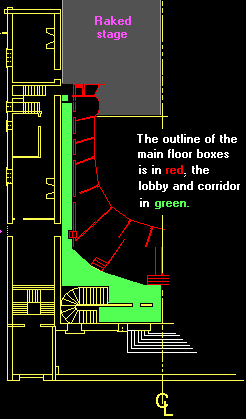 |
The boxes are lined with a pink colored paper, with small dark spots, and supported by pillars representing bundles of reeds (gilt) bound with red fillets; between the pillars, festoons of crimson curtains, with tassels intervening, and a profusion of glass chandeliers, form an assemblage that captivates the eye, and renders the whole a most pleasing spectacle. |